In chemical injection packages as well as hydraulic systems, one of the necessary components to increase the life of the system is the pulsation dampener or accumulator. This component, which usually does not have any special components and only requires periodic charging, is a long-lasting element for uniform flow in terms of flow rate and pressure. So that when the pump is operating, it is charged and slowly discharged with a slight drop in line pressure.
On this website, we aim to provide you with expert assistance in familiarizing yourself with different accumulators and providing quick access to datasheets and price lists. We hope to be successful in this goal.
Purpose of using the accumulator
- Prevent piping vibration
- Increasing the lifespan of piping
- Preventing damage to the reciprocating pump
- Converting intermittent and pulsed fluid flow into uniform flow
- Increasing pump dosing accuracy
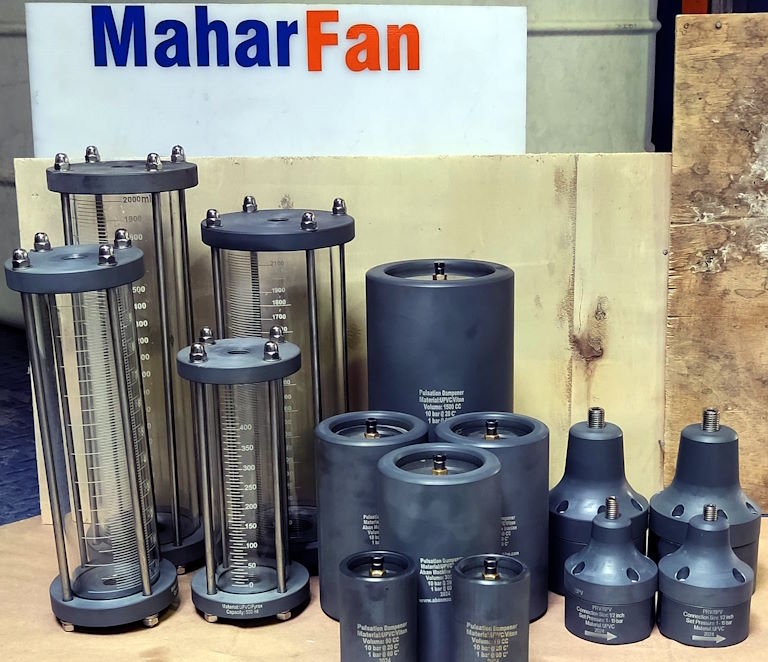
Types of flow stabilizers
Air trap equalizer
The simplest type of pulsation damper is the air trap type. In this type, as air is trapped in the chamber, a compressible volume is placed in the damper, which performs the work of compressing and releasing the pressure.
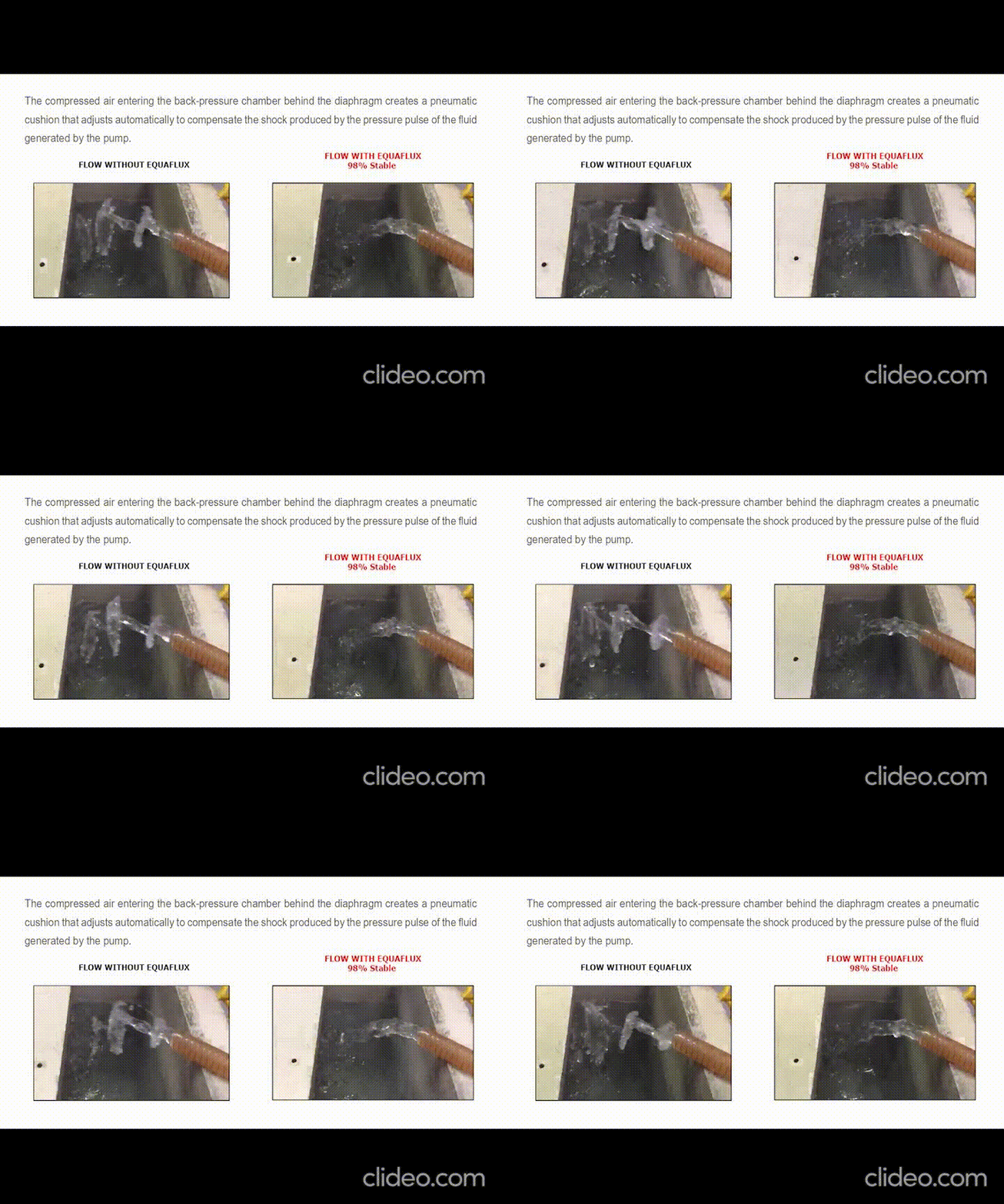
Diaphragm flow equalizer
This type is usually used at various pressures for high volumes. This type is usually used to dampen the flow of a diaphragm pump.
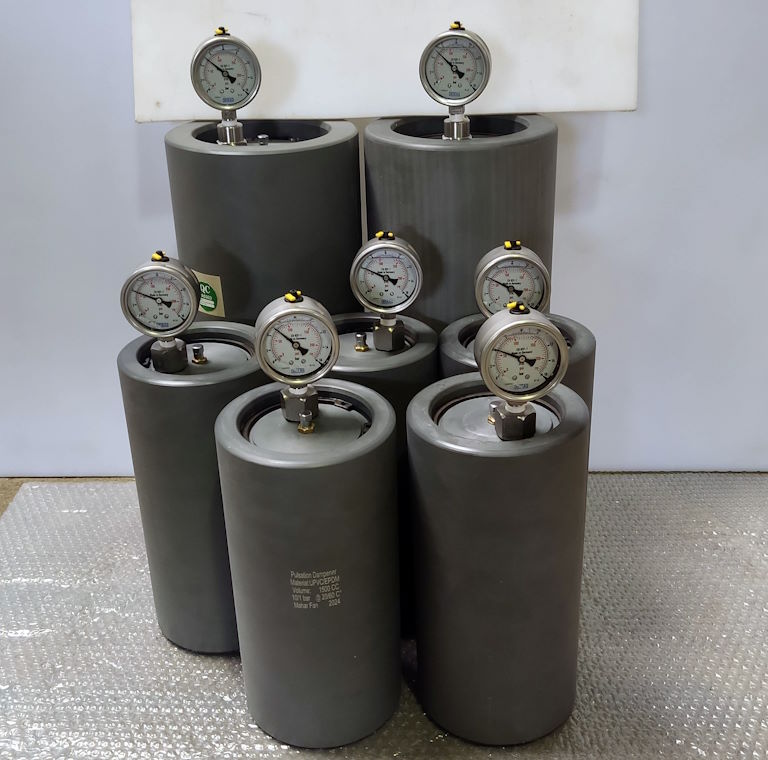
Volumetric size of flow equalizer
In general, choosing the accumulator size cannot be done very roughly because if you choose a damper size larger than needed, the dosing accuracy will be greatly reduced at the beginning of the pump operation and we will see a drop in flow rate.
To avoid this, we can refer to the dosing information of the pump and consider a volume of about 10 times each injection. However, if injection accuracy is not important, we go for a ratio of 40 to achieve a completely uniform flow.
Placing the pulsation dampener in the piping
It is necessary to ensure that the pulsation damper is placed after the dosing pump and before the pressure gauge. It is also better to use a back pressure valve between the damper and the gauge. If a back pressure valve or pressure relief valve is not used, the flow smoothing function will not be sufficient and the performance will be much lower.
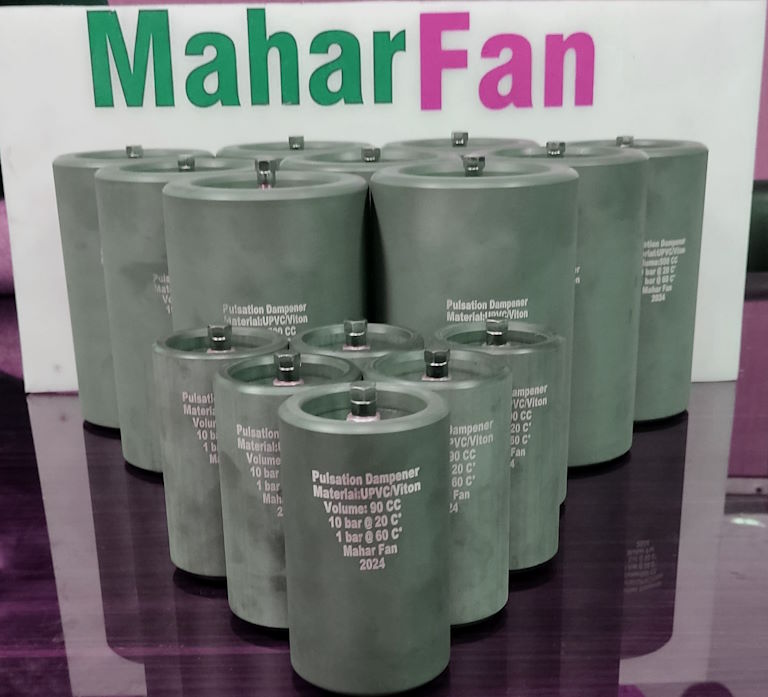
Introducing the Pulsation Dampener or Inline Accumulator
One of the most advanced types of dosing line accumulators is the inline pulsation dampener, which has its advantages and disadvantages. In general, they take up less space and perform better, but they are not suitable for Iran because it would be impossible to supply the relevant bladder from a German company.

Incorrect Pulsation Dampener Installations
Installing a damper after the pressure gauge
It is necessary to install the pressure gauge after the damper and at a distance from it to show the effect of the accumulator on the fluid pulse flow.
Not using a back pressure valve
This valve is necessary to reach the limit state of the pulsation dampener, and if it is not used, the dampener will not be properly charged and its performance will be severely affected by the injection line.
Sales and production of pulsation dampeners in Iran
Mahar Fan Abzah Company, with 22 years of experience in supplying accumulators and 10 years of experience in producing pulsation dampener bladders, is ready to cooperate and manufacture not only routine accumulators but also custom accumulators up to 200 bar pressure and up to 35 liters in size.
Routine Pulsation Dampeners Price List
To serve our valued buyers, this company has prepared a price list for routine accumulators and has also included the latest price update, which can be accessed at this link .